

Typical lifespans, and why they're only typical
You'll see these ranges from manufacturers and across the industry. They're averages over a lot of systems, not a promise about yours. Plenty of systems we work on fall outside them in both directions.
| System | Typical life | What matters most here |
|---|---|---|
| Central air conditioner | About 12 to 17 years | Hours run in June to September; the outdoor unit takes heat, hail, ice and grass |
| Gas furnace | About 15 to 20 years, sometimes longer | Heat exchanger condition; attic furnaces sit in a very hot space all summer |
| Heat pump | About 10 to 15 years | Runs in summer and winter, so it builds up hours faster than an AC |
General industry ranges, not Dowd data and not a warranty. Your system can do much better or much worse.
Why the wide spread? Two identical ACs installed on the same day can age very differently: one sized right, kept clean and shaded on the north side of the house; the other oversized, short-cycling, choked with cottonwood fluff and baking on the west side. Install quality, sizing and upkeep move the number more than the brand on the cabinet.
What wears systems out in Tulsa
Long, hot summers
An AC in Green Country doesn't get many days off between June and September. Weeks in the upper 90s with high humidity mean long run cycles, hot compressors and a lot of wear packed into four months. A heat pump does that and then heats the house all winter too.
Furnaces in the attic
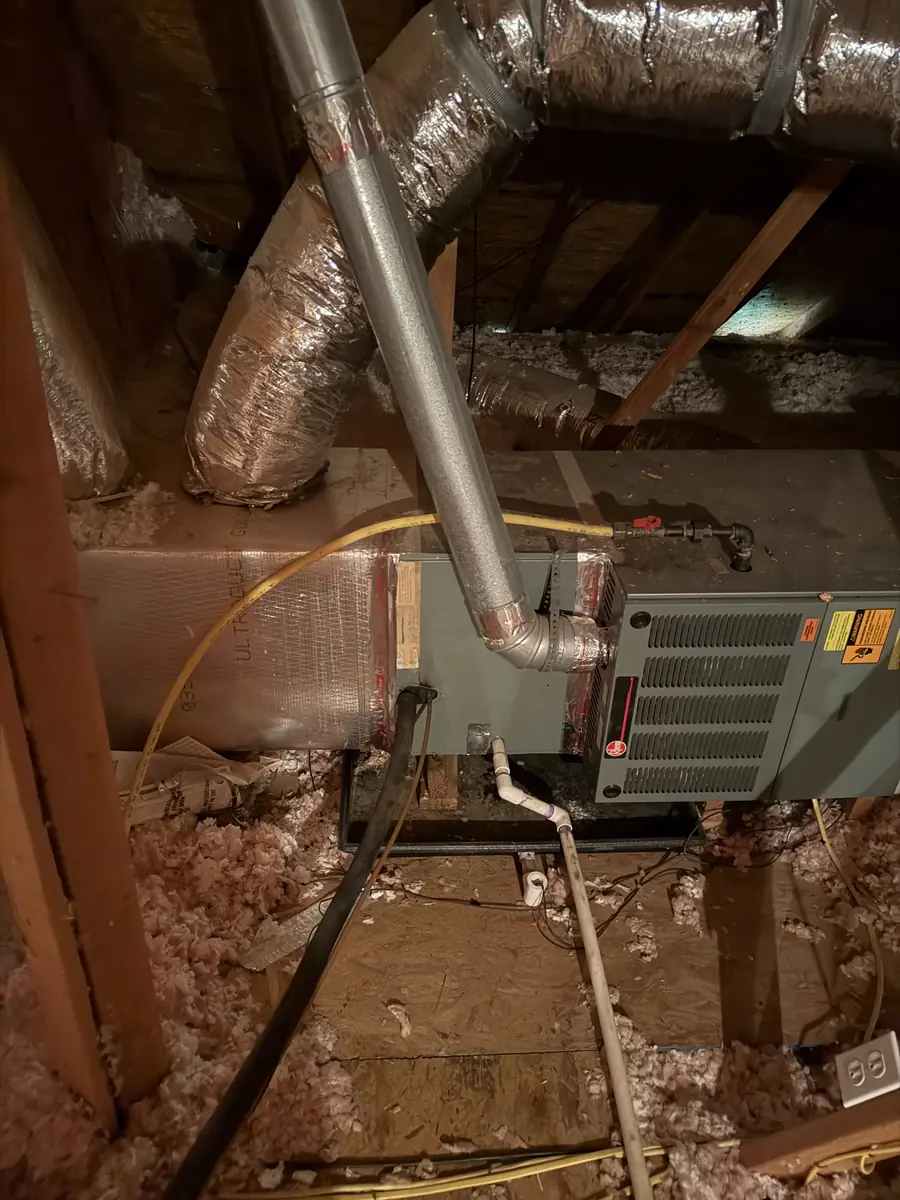
Many Tulsa-area homes have the furnace or air handler in the attic, and our estimate photos are full of them. Up there, the equipment spends the summer in an attic that can run well past 120 degrees, the AC coil next to it sweats into a drain pan and line that can clog or rust, and dust and insulation settle on everything. Because it's a climb to reach, filters and checkups get skipped more often than for a furnace in a hall closet.
Ice storms on the outdoor unit
Every few winters, freezing rain coats northeast Oklahoma. Ice can bend fan blades, load up the coil and bring limbs down on the unit. For an AC that's sitting idle, the risk is mostly physical damage. A heat pump is different: it makes your heat from that outdoor coil, so a thick shell of ice stops it working until it thaws or defrosts.
A little frost on a heat pump in winter is normal; it melts it off on its own. A solid block of ice is not. Switch the thermostat to emergency heat, don't chip at the fins (they bend and puncture easily), and call us. After a storm, it's worth clearing branches away from the unit and checking the fan turns freely before summer.
Maintenance, or the lack of it
A clogged filter or a coil packed with cottonwood fluff and grass clippings makes everything run hotter and longer. Most of the big failures we see started small: a weak capacitor straining a compressor, a slow refrigerant leak, a clogged drain. Two checkups a year catch most of those. Our maintenance plans include two visits a year, one for cooling and one for heating.
What our records show
Lifespan charts make it sound like systems drop dead on schedule. Our customer list says otherwise.

"Contacted 3 companies; Dowd showed up Same Day. Brian was knowledgeable, transparent, and had the blower replacement finished within an hour. Although my system is a 26-yr-old Trane, he had all the parts required to repair it. A++ Highly recommend!!"
How to read your system's age
Your house's age, or the year you moved in, can be off by a decade. The data plate is the real answer, and it takes two minutes to find.
- 1
Outdoor unit: look on the side or back panel, often near where the electrical lines go in. It's a printed label, sometimes faded or peeling.
- 2
Furnace or air handler: check the side of the cabinet or the inside of the front door. If it's behind a panel on a gas furnace, leave it for the tech.
- 3
Find the date: it's marked MFD, MFR DATE or MFD/FAB, written like 01/99, 02/2004 or 07/2014 (month and year).
- 4
No date? The serial number usually holds it. On newer Rheem and Ruud units, a serial starting W2614 means week 26 of 2014. Other brands code it differently; our techs can read any of them.
- 5
Check the refrigerant line: R-22 (or R22) means an older system on a refrigerant that's no longer made. R-410A or R-454B means newer.
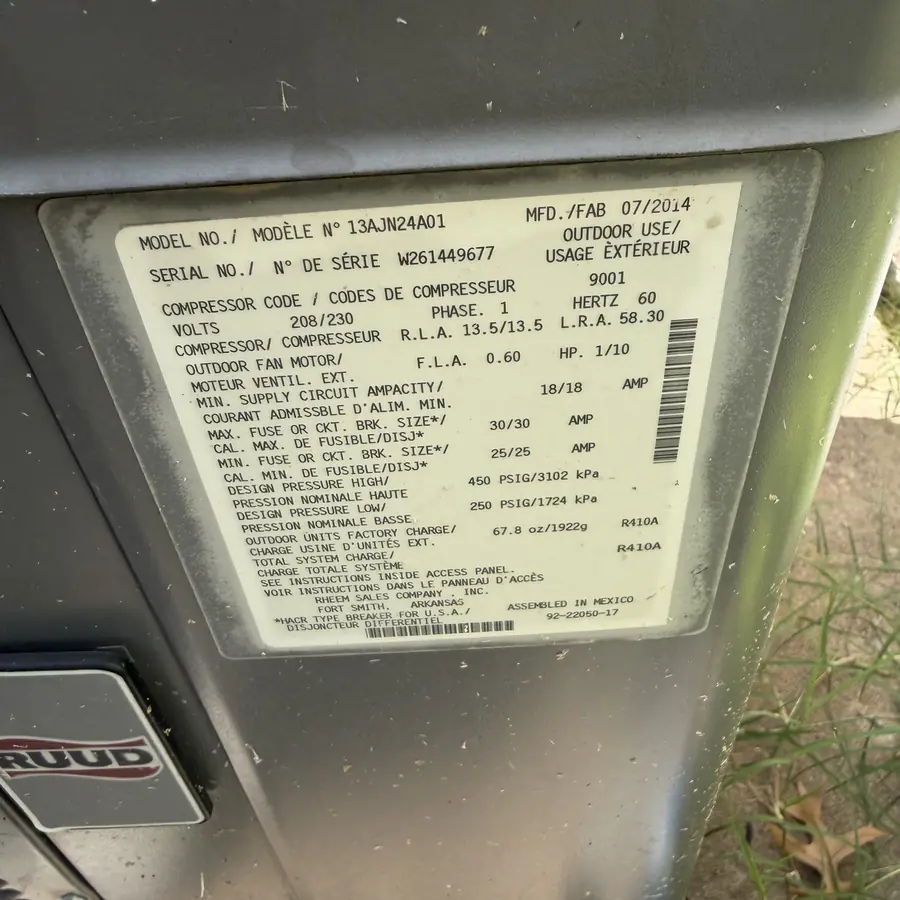
If your plate says R-22, read our guide to R-22 systems before your next repair. It changes the math on leaks and compressor failures.
What to do with an older system
An old system that heats, cools and doesn't leak doesn't need replacing because of a birthday. Here's what we'd suggest instead.
- 12 years or older: have it checked before winter. Ask about our safety check for older systems: a carbon monoxide test, a heat exchanger inspection and a short written report with photos that says fine, fix soon, or plan to replace.
- When something breaks: weigh the repair against what it has left. Our repair or replace guide walks through how our techs decide, and we'd rather fix a system that has years in it.
- 15 years or older: get a replacement price before you need one, so a failure in July or January doesn't force a rushed decision.
If it is time, most of the AC and gas furnace systems we installed in the last 12 months came in between about $7,900 and $10,100. That's the invoiced total for equipment, labor and materials, before rebates, checked October 2026, and your quote depends on the house. Our Tulsa replacement cost page has the full table, and if you're a PSO customer, a qualifying heat pump may earn a PSO rebate if you qualify. We check before we promise.